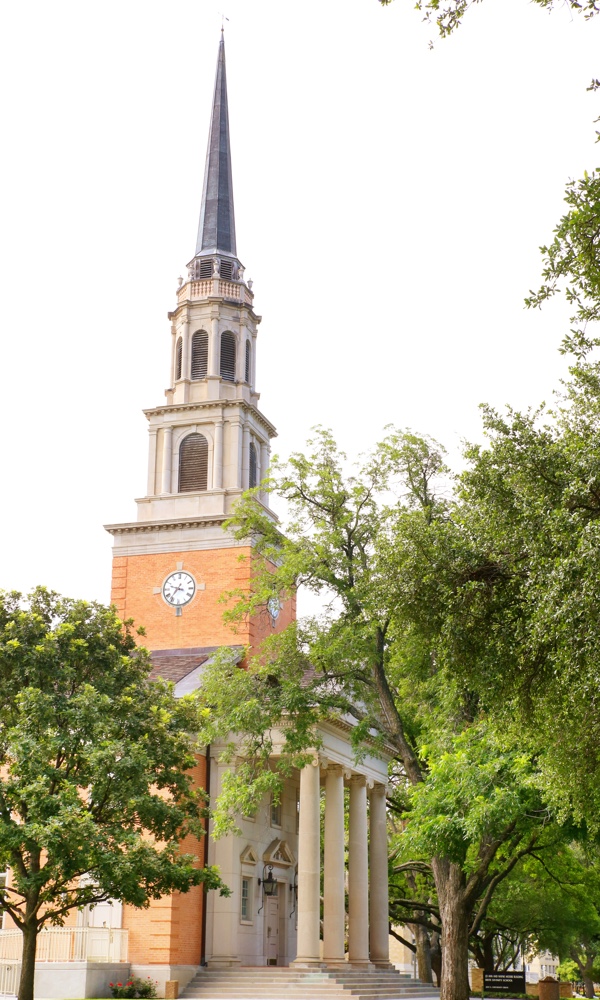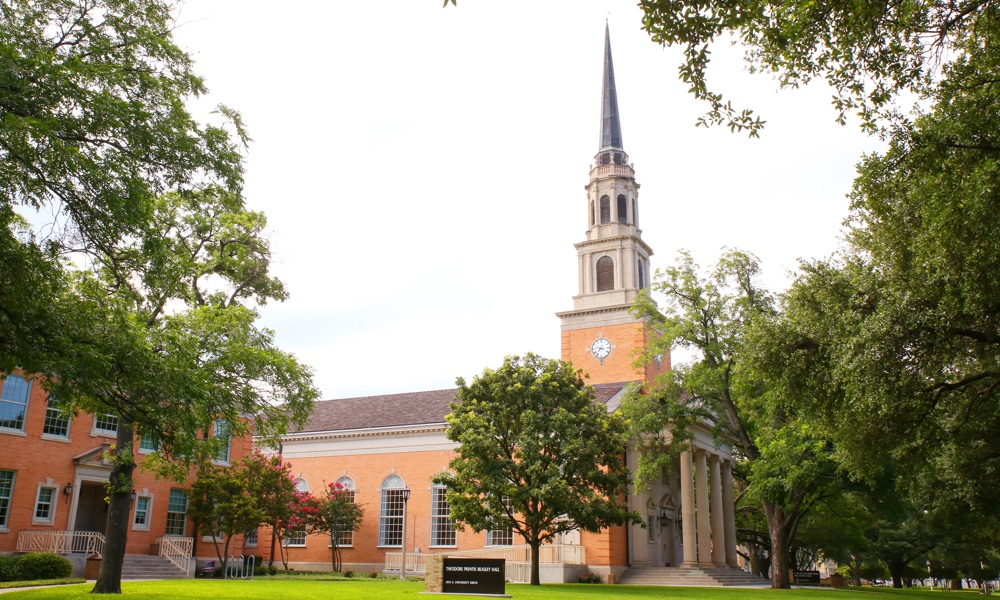
Robert Carr Chapel, dedicated in 1954, has hosted events on the TCU campus for over 70 years. It is a landmark for generations of Horned Frogs and the Fort Worth community. From campus worship services to weddings, the chapel welcomes a variety of services and people.
Renovated in 2016, the chapel now boasts improved accessibility, enhanced usability, and a TCU-friendly purple aisle. Many design elements from American Colonial churches are evident in the chapel’s architecture, including the iconic stone columns, spire, brass chandeliers, Palladian windows and classically designed chancel, and these elements remain unchanged post-renovation.
Robert Carr Chapel welcomes an average of 30,000 distinct guests each year as it is host to more than 100 weddings and 400 events. If you have questions about hosting your upcoming event in the chapel, please contact us at chapel@tcu.edu.
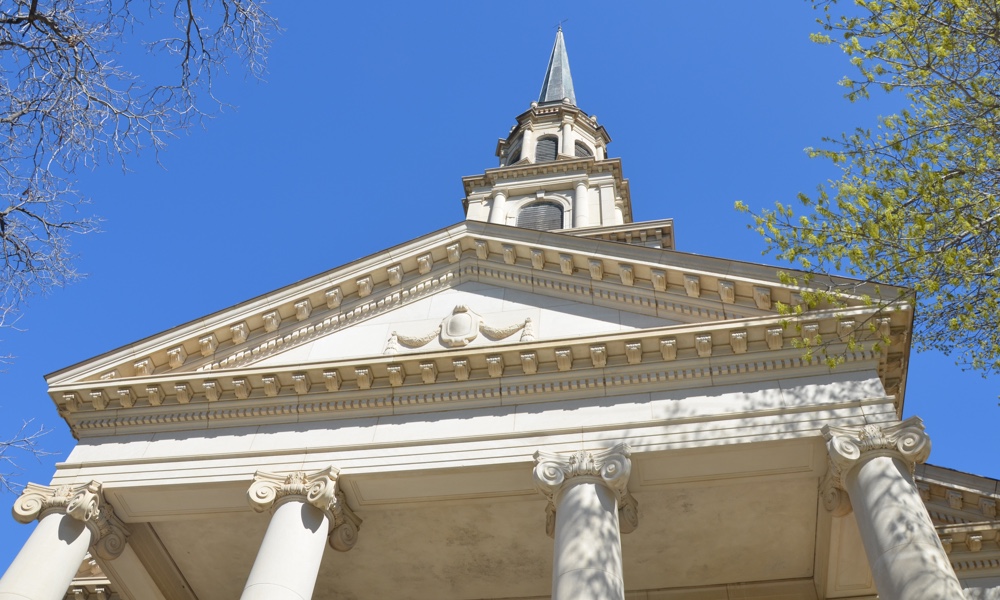
Robert Carr Chapel, built in 1952, thanks to a kind gift from San Angelo rancher and oil man, Robert G. Carr, is a landmark for generations of Horned Frogs and the Fort Worth community, serving as a point of entry to TCU and a place of worship. Many design elements from American Colonial churches are evident in the chapel’s architecture thanks to the work of Frances Swain Sadler, wife of TCU President McGruder Ellis Sadler. These include the iconic stone columns, spire, brass chandeliers, Palladian windows and classically designed chancel.
The chapel was opened in May of 1954 with a beautiful dedication service led by Dr. Granville T. Walker with the organ played by then university organist Dr. Emmett G. Smith. The chapel was rededicated after its 2016-2017 renovation on September 20th, 2017.
The wife of then TCU President M.E. Sadler, Frances Sadler, was instrumental in the design of the chapel. Mrs. Sadler traveled throughout the eastern United States studying both architectural and decorative styles of American Colonial churches looking for inspiration for the Chapel. The beautiful elegance of Robert Carr Chapel is a reflection of her taste, travels, and influences.
- The spire is an exact replica of the one atop the famous Old Lyme Church in Connecticut.
- The brass chandeliers are after the design of those in St. Michael’s Church in Charleston, South Carolina.
- The pulpit is patterned after those in King’s Chapel of Boston & Christ Church in Cambridge.
- The arched heads of the Palladian windows that grace both the chapel and the cloister walls reflect the style of Mount Vernon and a church in Watertown, Massachusetts.
Information from Walking TCU: A Historic Perspective by Joann Hewitt Swaim.
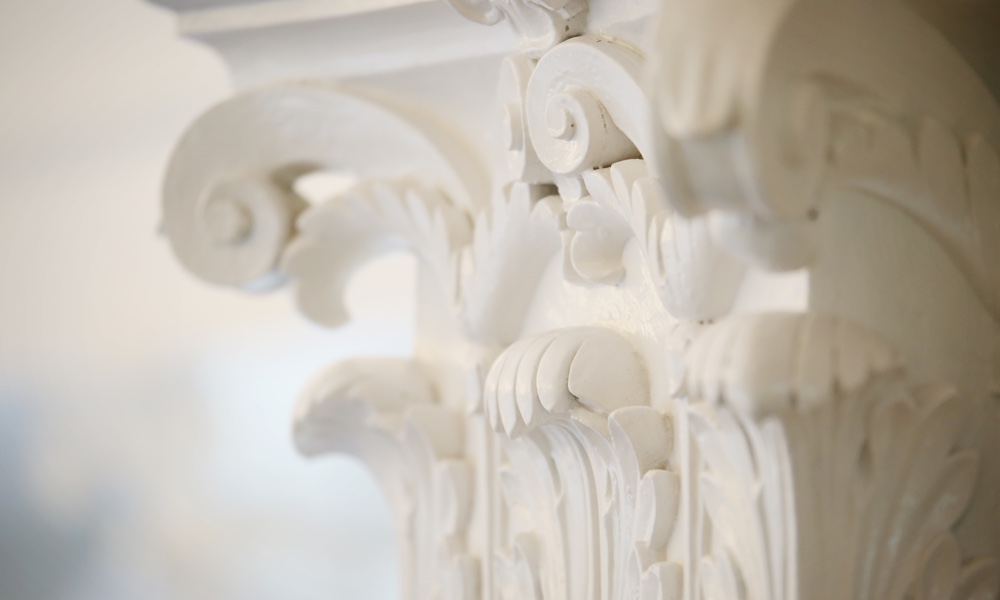
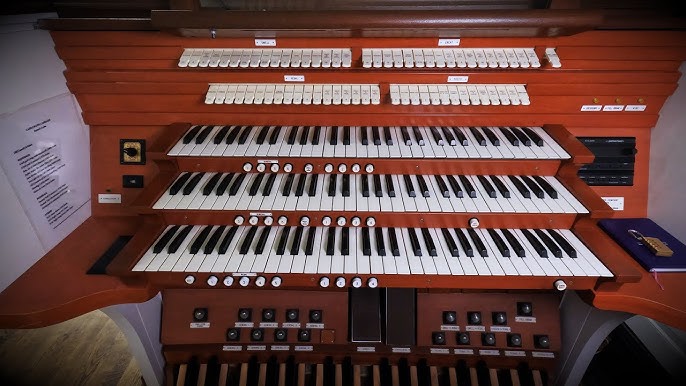
The Robert Carr Chapel organ was built by the Ross King Organ Company of Fort Worth. In 1979 it replaced the original two-keyboard, fourteen-stop Reuter organ. The King Organ, valued at $295,000, has three keyboards and thirty-six stops.
The chapel carillon, built by the Cincinnati firm Verdin, was installed in 1984 replacing an earlier carillon provided by Robert Carr. The Verdin carillon plays the short measures of the TCU alma mater before striking each hour during the daytime and is a beloved and well known sound on the TCU campus.
Winston Churchill once said that we shape our buildings and that thereafter they shape us. This is especially true of the chapel and how it’s shaped countless generations. When renovations occur a conscious effort always takes place to maintain the spirit, character and architectural integrity of this beloved space while responding to the need for increased accessibility and usability.
The most recent renovations, completed in the spring of 2017, made the chapel fully accessible throughout. It also refreshed the facility itself with new floors, fresh paint and restored pews among other improvements. The organ was fully digitized and mobilized, and a new state of the art AV system was installed.
- 2010 – Installation of an expanded sound system
- 2013 – The Chapel obtained a brand-new Mason & Hamlin piano
- 2017 – Renovations were completed with the goal of addressing accessibility, usability and refreshing the physical appearance of the building.